Barabazar, Chandannagar, West Bengal 712136

Barabazar, Chandannagar, West Bengal 712136
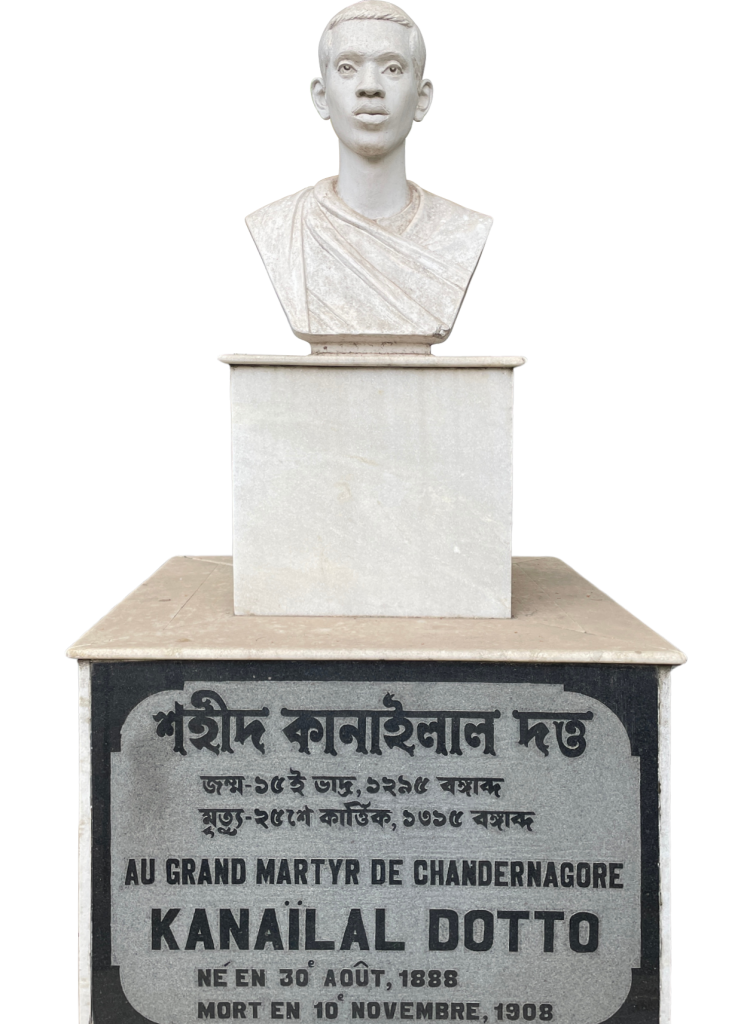
Kanailal Dutta, a prominent figure in the British-Indian freedom movement, was a revolutionary who sowed the seeds of rebellion across India. Born on August 30, 1888, in the French colony of Chandernagore (then known as “Farasdanga”), he was destined for a short but impactful life dedicated to the liberation of his homeland. His birth on Janmashtami earned him the name ‘Kanailal.’
Kanailal’s revolutionary journey began at Duplex College (now Chandernagore Kanailal Vidyamandir), where he was deeply influenced by his principal, Charuchandra Roy. Under Roy’s guidance, he was initiated into the world of revolutionary thought and trained in the use of arms. He actively formed several revolutionary societies in Chandernagore and was in close contact with other key figures like Rash Behari Bose. After graduating from Hooghly Mohsin College, he became a more active member of a revolutionary group in Calcutta.
His most defining moment came during his imprisonment for the Alipore Bomb Conspiracy Case in 1908. Inside Alipore Jail, he discovered that Narendranath Goswami, a fellow revolutionary, had turned into a police approver. Fearing that Goswami’s testimony would lead to the execution of prominent leaders like Aurobindo Ghosh and Barindra Ghosh, Kanailal, along with his associate Satyendranath Bose, decided to silence the traitor. On August 31, 1908, they cunningly lured Goswami to the jail hospital and shot him dead.
Despite the fact that he could have appealed the decision of the lower court, Kanailal bravely refused, stating with firm resolve, “There shall be no appeal.” His courage was so profound that even Acharya Prafulla Chandra Ray praised his use of grammar, remarking, “Kanai has taught us where to use ‘shall’ and where to use ‘will.'”
On November 10, 1908, Kanailal Dutta was executed by hanging at the young age of 20. His death was not a moment of sorrow but a public spectacle of inspiration. Thousands of people joined his funeral procession, chanting revolutionary slogans and showering his body with flowers. The sheer scale of the crowd left the British so shaken that they implemented a new rule: the bodies of revolutionaries would no longer be handed over to their families for funeral rites. Kanailal Dutta’s ultimate sacrifice transformed him from a young revolutionary into an immortal martyr, whose legacy continues to be a source of national pride and inspiration.